Introduction
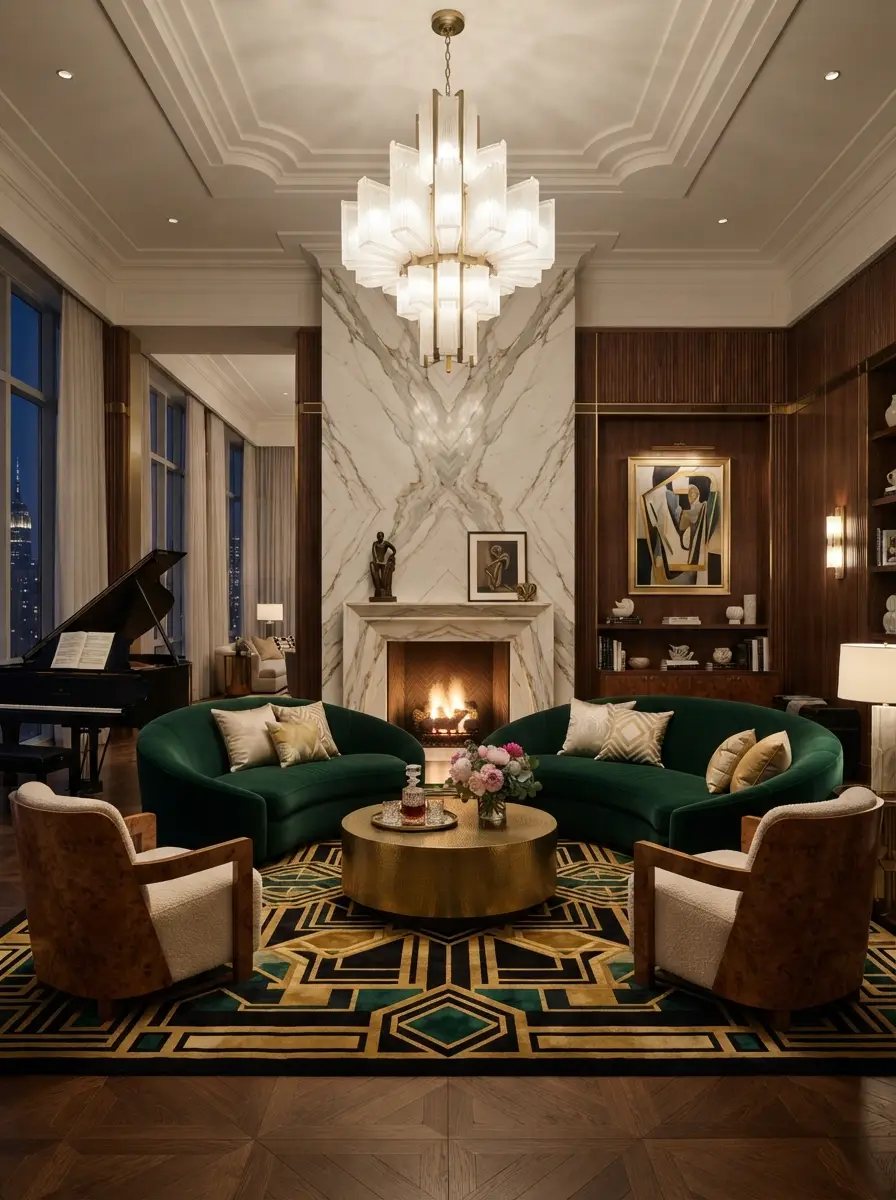
Art Deco is far more than a fleeting design trend; it is a permanent architectural and interior revolution that fundamentally changed how we view luxury. Born in Paris in the 1920s before exploding across the globe, the Arts Décoratifs movement emerged as a glamorous, optimistic rebellion against the starkness of World War I. It was an era defined by the Chrysler Building piercing the New York skyline, the lavish excess of The Great Gatsby, and a profound fascination with machine-age modernity mixed with ancient geometric motifs.
Today, Art Deco interior design remains the absolute pinnacle of sophisticated elegance. It is the perfect, intoxicating blend of unabashed luxury and rigorous geometric order. Where other design styles rely on cluttered layering to achieve warmth, Art Deco achieves its impact through the sheer quality of its materials: rich veined marbles, polished brass, heavily textured velvets, and flawless lacquered woods.
In the contemporary design landscape of 2026, we are seeing a massive resurgence of “Neo-Deco.” However, today’s interpretation moves away from the overly theatrical, theme-park look of the past. Instead, it combines the vintage glamour and striking silhouettes of the 1930s with modern functionality, cleaner lines, and a more curated approach to space. Whether you are undertaking a massive architectural renovation of a historic home or simply looking to inject a profound sense of character into a new build, this aesthetic guarantees a space that feels deeply intentional and undeniably expensive.
Moving beyond simple styling tips, this comprehensive guide dives deep into the foundational design elements, spatial arrangements, and material choices that define this iconic style. Here are 17 stunning Art Deco interior design ideas and architectural concepts that will help you craft a home filled with unmatched elegance, drama, and timeless character.
1. The Sculptural, Jewel-Toned Velvet Sofa
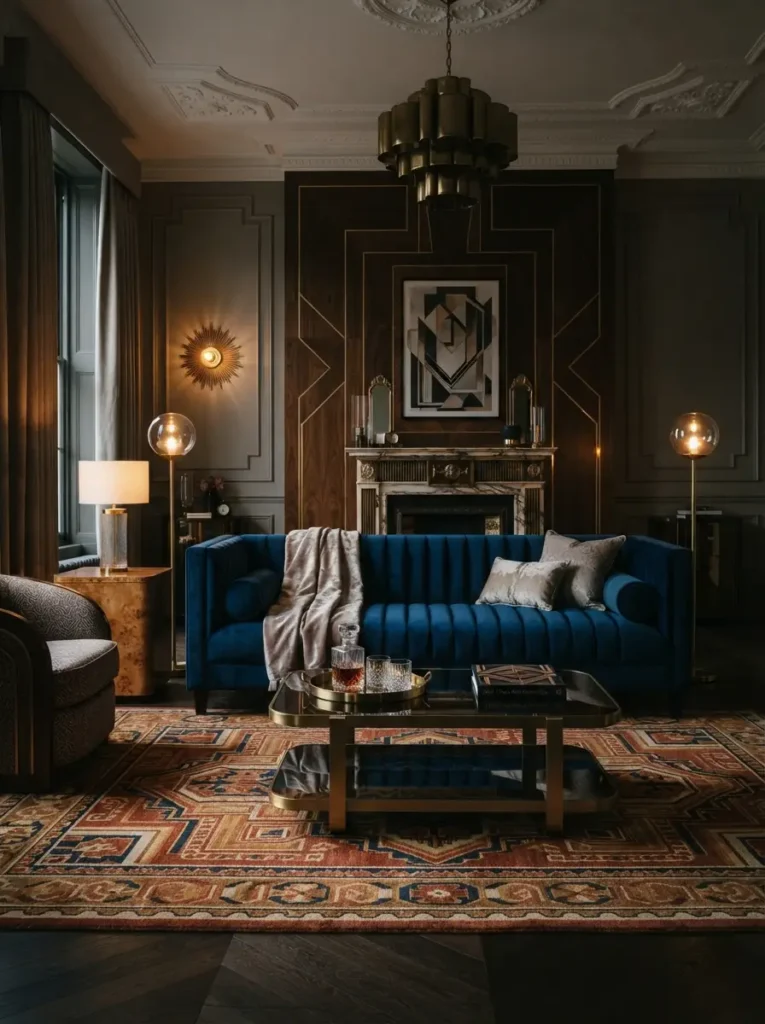
In Art Deco design, furniture is treated as functional sculpture. Nothing anchors a living room quite like a massive, architecturally distinct velvet sofa. Moving away from standard, slouchy modern sectionals, the Deco sofa demands attention through structure and tactile richness.
- The Design Concept: Look for sofas featuring channel tufting (deep, vertical grooves that create a ribbed effect), tuxedo arms (where the arms and back are the same height), or dramatic, sweeping curved backs that mimic the shape of a shell.
- Color & Material Palette: Velvet is non-negotiable, as it absorbs and reflects light in a way no other fabric can. Opt for highly saturated jewel tones that serve as the room’s grounding color: deep emerald green, crushing sapphire blue, rich plum, or a dramatic, moody charcoal.
- Architectural Integration: To maximize the impact, float this sofa in the center of the room rather than pushing it against a wall. Pair it with a highly geometric, low-profile brass and glass coffee table to contrast the heavy, plush weight of the upholstery with sleek, transparent modernism.
2. The Iconic Sunburst and Starburst Motifs
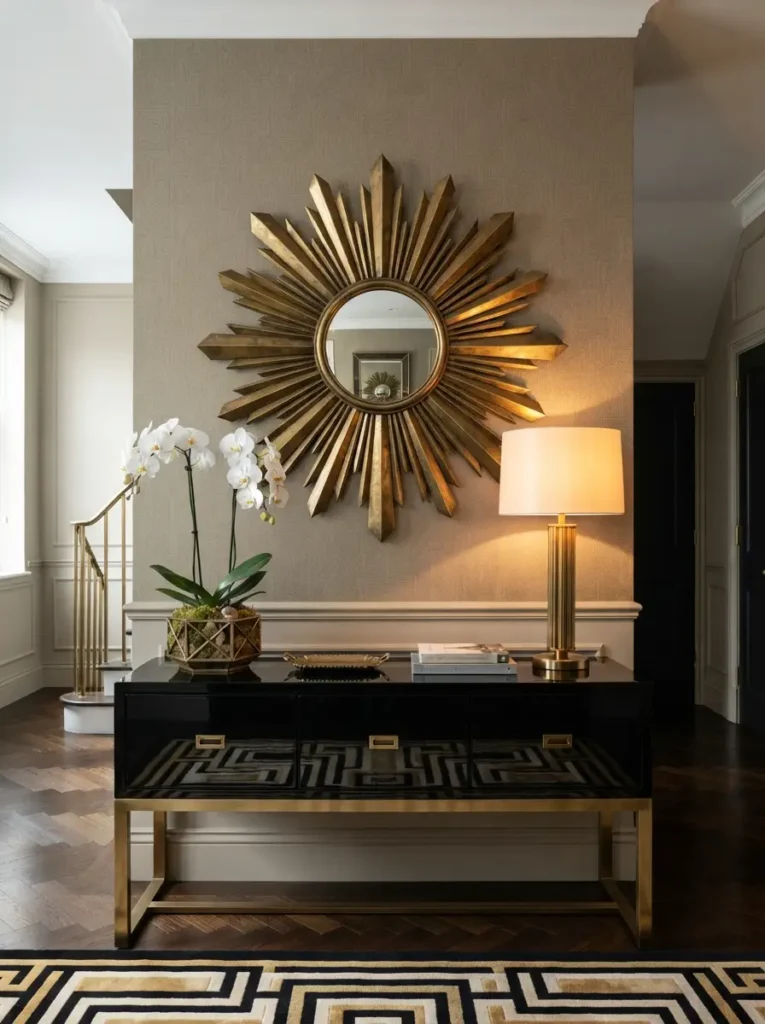
The sunburst is arguably the most recognizable and enduring emblem of the Art Deco era. Symbolizing the dawn of a new, modern age, this motif radiates optimism and explosive energy.
- The Design Concept: While commonly seen in mirrors, the sunburst design can be integrated into the actual architecture of the home. Consider custom wood veneer inlay on cabinetry, stained glass transom windows above interior doors, or custom floor medallions using contrasting stones.
- Color & Material Palette: Antique brass, polished gold, and heavily antiqued mirror glass. The metal should feel heavy and cast, not flimsy or stamped.
- Architectural Integration: If using a massive sunburst mirror, treat it as the crown jewel of the room. It requires negative space to breathe. Mount it above a monolithic marble fireplace surround or perfectly centered over a black lacquered entryway console. The radiating lines of the mirror naturally draw the eye inward, establishing an immediate, powerful focal point.
3. Bold, Large-Scale Geometric Wallpaper
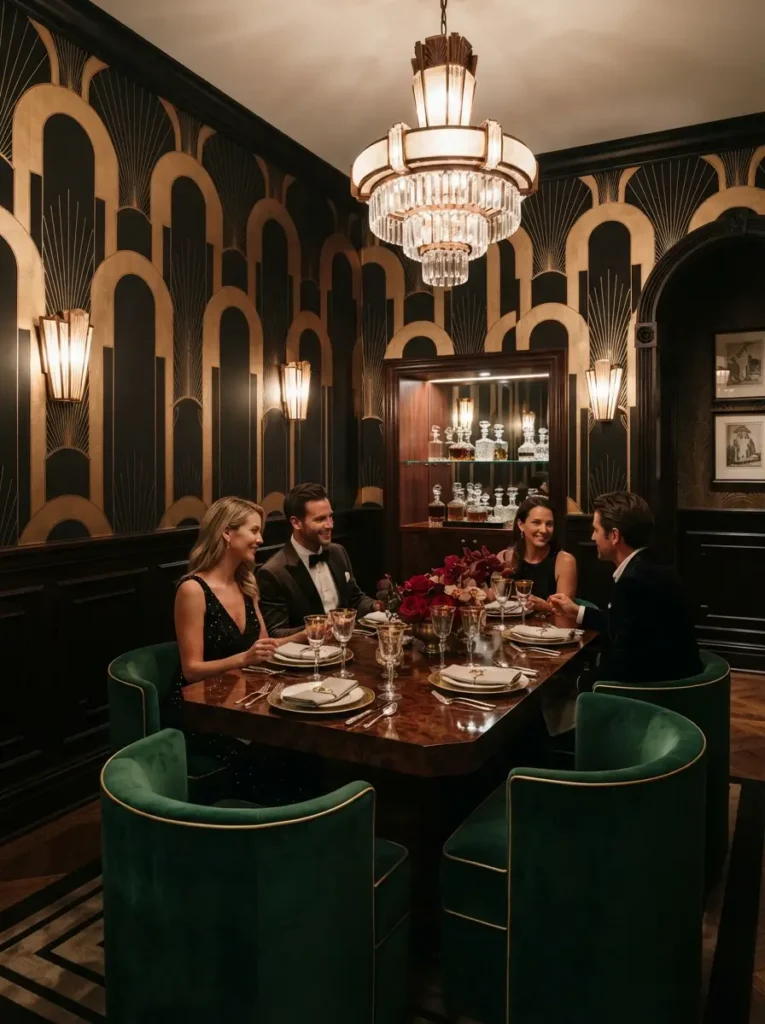
Wall treatments in an Art Deco home are never an afterthought; they are the primary canvas that dictates the geometry of the entire room. Art Deco fundamentally rejects delicate, ditzy florals in favor of strong, repeating, mathematical precision.
- The Design Concept: The patterns are deeply architectural. Look for repeating arches, sharp chevrons, overlapping fan motifs, or stepped ziggurat designs inspired by ancient Babylonian and Egyptian architecture (which heavily influenced 1920s designers).
- Color & Material Palette: The best Deco wallpapers utilize metallic inks that catch the light as you move through the room. Combinations like deep navy and brushed brass, matte black and foil gold, or soft cream and silver offer sophisticated contrast.
- Architectural Integration: Use these bold prints in transitional or enclosed spaces to create “jewel box” rooms. A dining room enveloped entirely in geometric wallpaper, paired with dark wainscoting, creates an incredibly intimate, cinematic dining experience.
4. High-Contrast, Dramatically Veined Marble
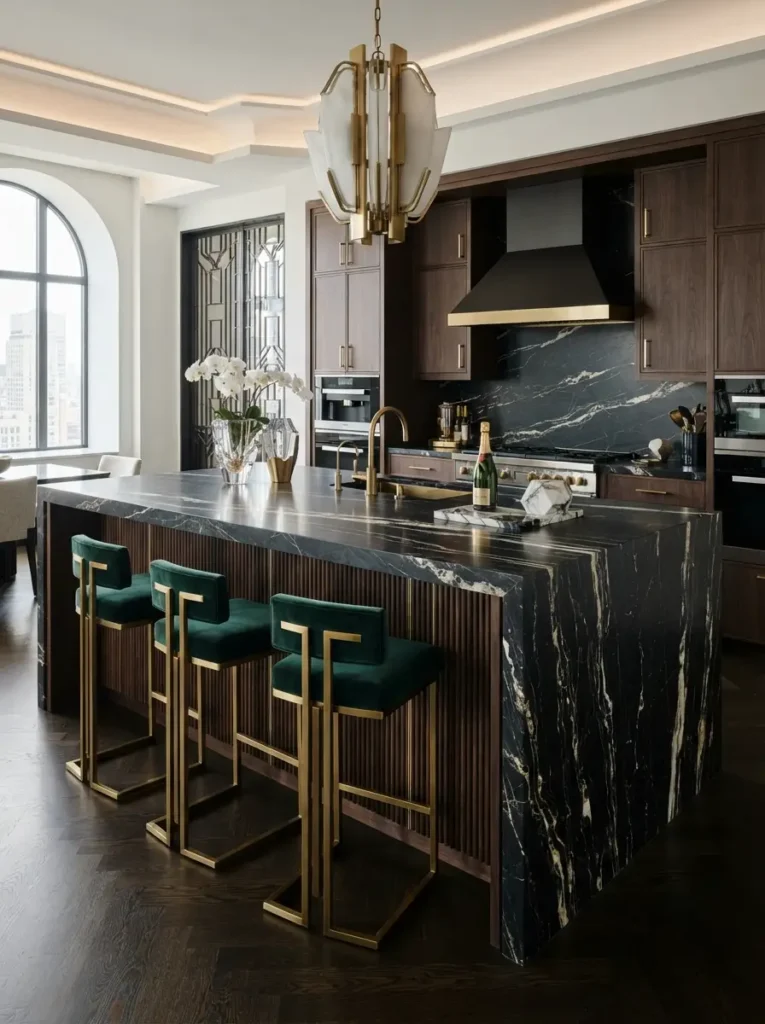
Marble is the foundational stone of luxury, but Art Deco demands a specific approach to this material. It rejects subtle, quiet stones in favor of marble with aggressive, highly contrasting, lightning-strike veining.
- The Design Concept: Marble is used monolithically. Think massive, thick-cut slabs used for dining room tables, entire kitchen backsplashes that span to the ceiling, or floating bathroom vanities.
- Color & Material Palette: Nero Marquina (pitch black with striking white veins), Calacatta Gold (creamy white with thick grey and gold ribbons), or rich, exotic Verde Alpi (deep green marble).
- Architectural Integration: The key to modern Deco is combining this ancient, heavy stone with sleek, machine-age metals. A dark green marble kitchen island sitting atop cylindrical, fluted brass legs beautifully captures the tension between earth and industry that defines the era.
5. Architectural Brass and Warm Metallic Accents
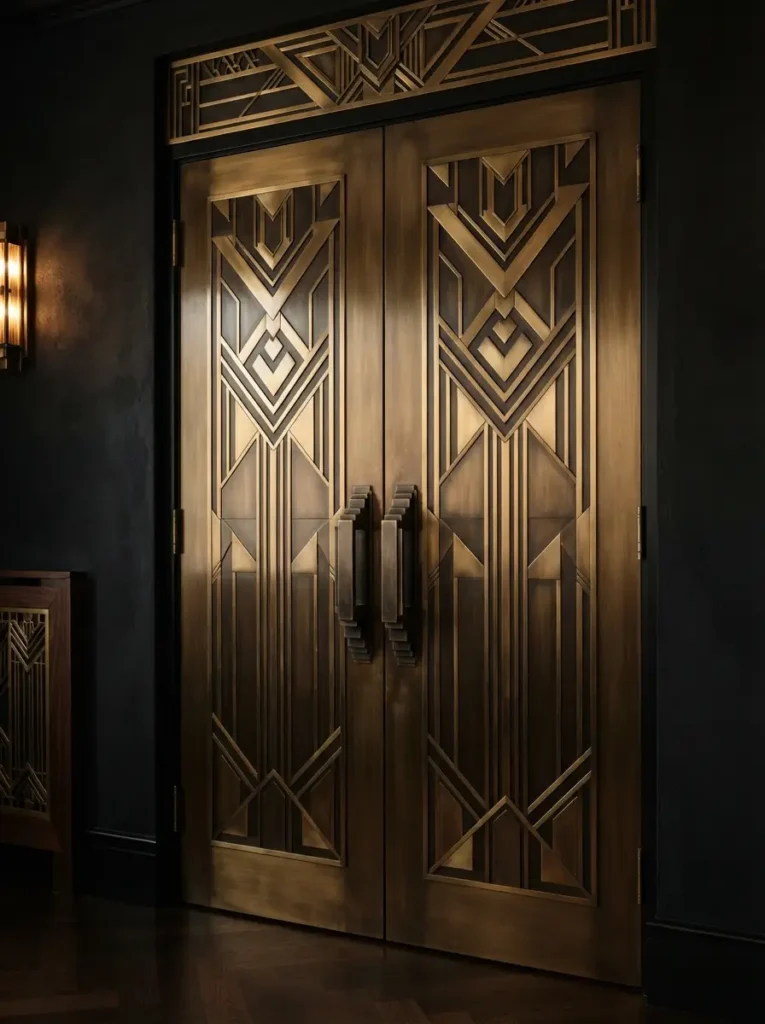
Silver and chrome belong to the mid-century; Art Deco is deeply rooted in the warmth, weight, and glamour of brass, bronze, and gold. In a Deco home, metal is treated as a primary design material, not just a finishing touch.
- The Design Concept: Integrate brass into the hardscaping of the room. This means brass inlay strips set into terrazzo flooring, heavy brushed brass door frames, and thick, geometric cabinet hardware that feels substantial in the hand.
- Color & Material Palette: Unlacquered brass that develops a living patina over time, or heavily polished brass that acts almost like a mirror. Avoid anything described as “champagne bronze” or overly brushed, as it loses the necessary Deco high-glamour shine.
- Architectural Integration: Use metallic finishes to outline and define space. A thin strip of brass separating a transition from wood flooring to marble tile, or brass banding wrapping around a kitchen hood, provides that quintessential 1920s attention to bespoke detail.
6. Cascading and Tiered Statement Chandeliers
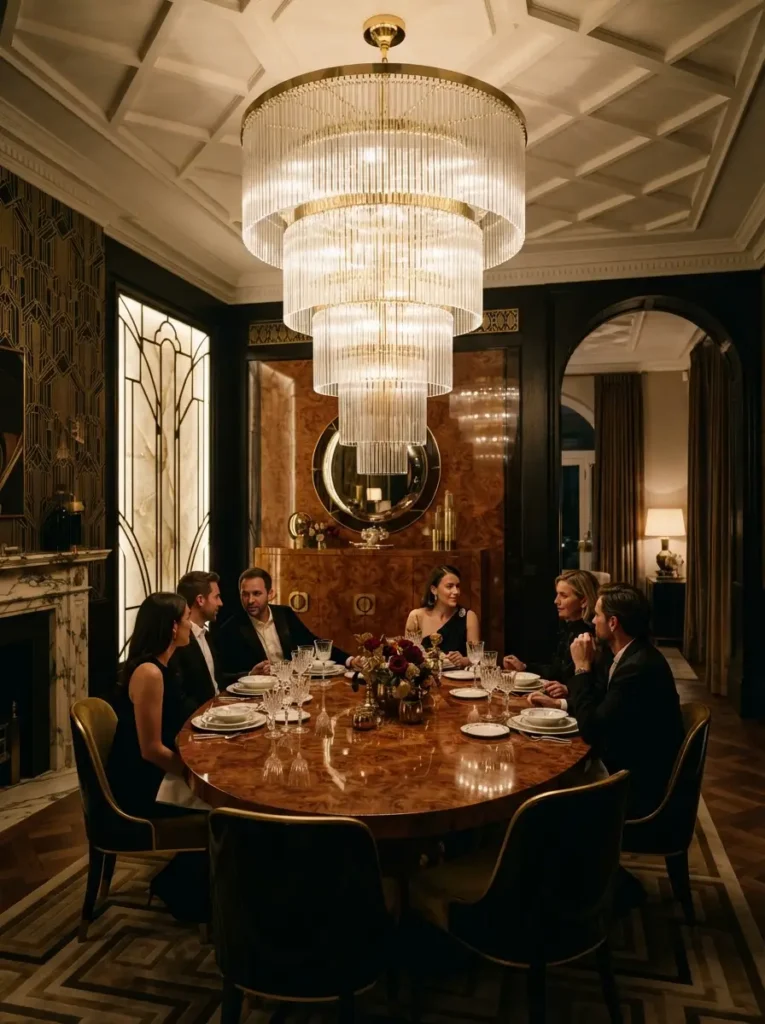
In Art Deco design, lighting is never invisible. Lighting fixtures are massive, structural, and serve as suspended, glowing sculptures that dictate the scale of the room.
- The Design Concept: The silhouettes are strictly organized. Look for tiered, wedding-cake structures made of elongated glass rods, frosted glass globes held in rigid geometric brass cages, or cascading crystal prisms that form a sharp V-shape.
- Color & Material Palette: Frosted white glass, clear ribbed glass, polished nickel, and brass. The light emitted should be warm, diffused, and cinematic, avoiding harsh, direct glare.
- Architectural Integration: Scale is everything. A Deco chandelier should feel slightly oversized for the space. Dropping a massive, tiered glass rod chandelier directly over a glossy burl wood dining table lowers the visual ceiling and creates an intimate, glamorous room-within-a-room.
7. The Rigorous Application of Symmetry
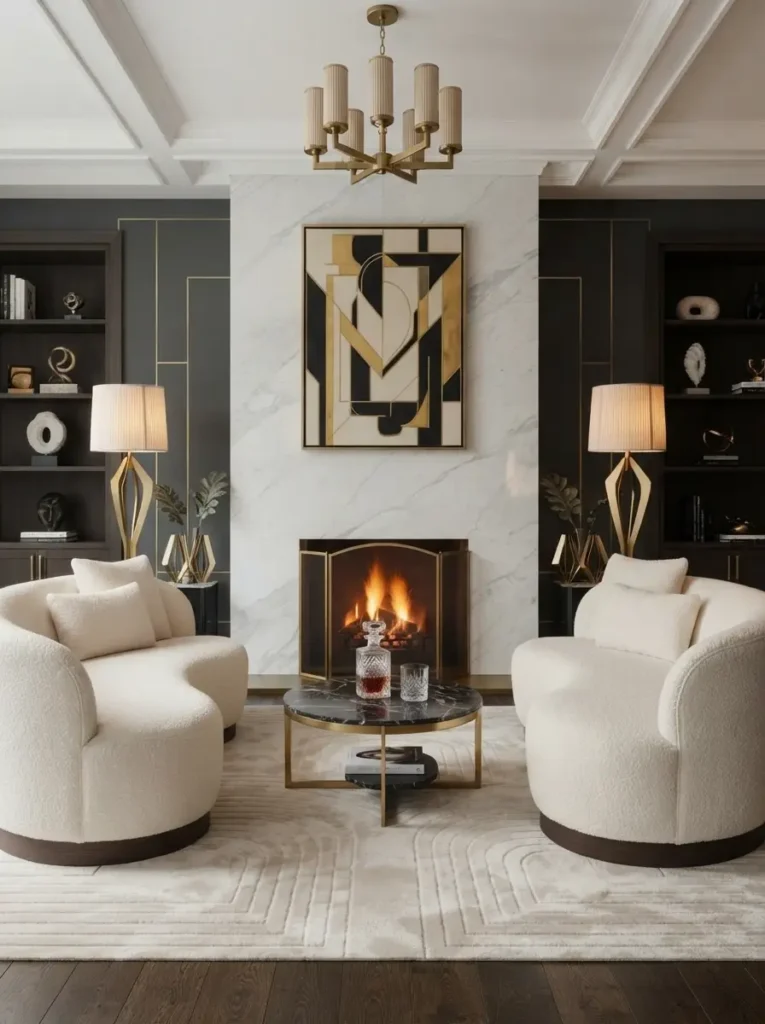
While bohemian styles thrive on eclectic, off-kilter arrangements, Art Deco demands absolute control, order, and symmetry. This design principle borrows heavily from the grand, symmetrical layouts of classical Beaux-Arts architecture.
- The Design Concept: Rooms are designed with a central axis. Every element on the left side of the room is mirrored on the right. This creates a psychological sense of calm, authority, and profound elegance.
- Color & Material Palette: Consistent framing. If you have a dark wood side table on one side of a sofa, the exact same wood tone must be on the other.
- Architectural Integration: Flank a central fireplace with two perfectly identical velvet lounge chairs. Place matching, towering brass table lamps on either side of a master bed or a dining room sideboard. This rigorous mirroring makes any room feel instantly more expensive and intentional.
8. The Dramatic Black and Gold Palette
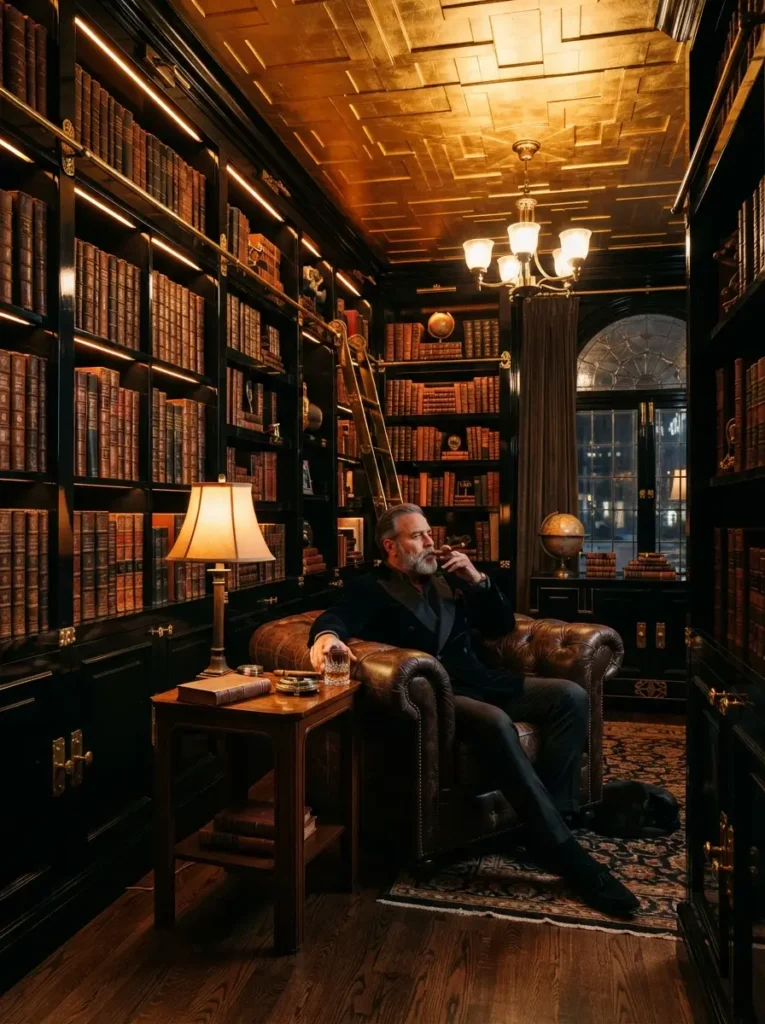
No color combination is more intrinsically linked to the extravagance of the Roaring Twenties than black and gold. It is a high-drama, high-contrast palette that evokes the feeling of a secretive, luxury speakeasy.
- The Design Concept: The black provides an endless, deep void, while the gold provides the illuminating structure. This is not a subtle look; it is meant to be moody, masculine, and dripping with affluence.
- Color & Material Palette: High-gloss black lacquer (a very popular 1920s finish), ebonized oak, matte black plaster walls paired with gold leafing, polished brass, and gold-threaded textiles.
- Architectural Integration: Paint a library, home office, or powder room floor-to-ceiling in a rich, lacquered black. The high-gloss finish reflects light, keeping the space from feeling like a cave. Punctuate the darkness with heavy gold hardware, gold-framed artwork, and warm amber lighting to create a seductive, enveloping space.
9. Sensuous Curves and Fluted Detailing
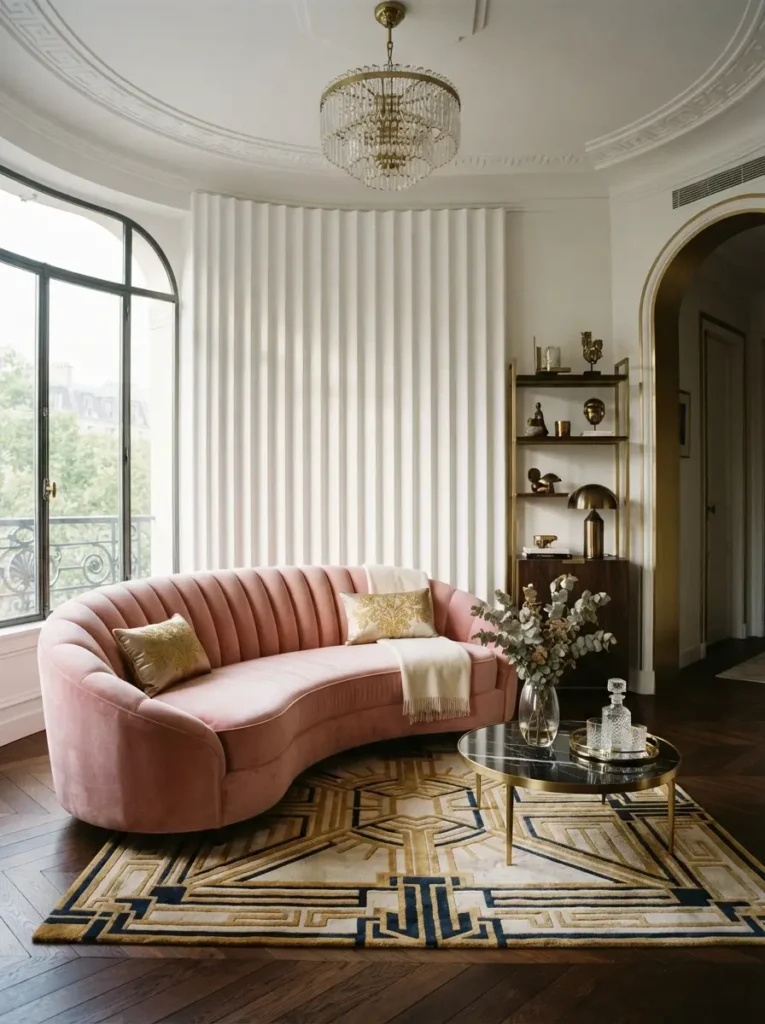
While Art Deco is famous for its sharp zig-zags and chevrons, it achieves perfection by balancing those hard lines with sweeping, sensuous curves. This aerodynamic, streamlined look gained popularity in the 1930s (often called Streamline Moderne).
- The Design Concept: Incorporate curved, barrel-backed chairs, kidney-shaped sofas, and rounded kitchen islands. Pair these shapes with fluting—the repeated vertical grooving carved into wood, plaster, or stone.
- Color & Material Palette: Soft, tactile materials like bouclé, mohair, and plaster. The fluting creates a rhythmic play of shadow and light across the surface of the material.
- Architectural Integration: A kitchen island featuring a heavily fluted, curved wooden base topped with a stark, flat slab of marble creates an architectural masterpiece. The curves soften the room, inviting movement and flow, while the fluting provides strict vertical order.
10. Antiqued Mirrors and Lacquered Surfaces
Art Deco interiors are designed to gleam. The use of highly reflective surfaces was initially a clever way to bounce the limited light of early electric bulbs around a room, but it quickly became a hallmark of Deco opulence.
- The Design Concept: Move beyond basic flat mirrors. Utilize verre églomisé (glass gilded with gold or silver leaf on the back) or heavily antiqued, smoked mirrors. Incorporate high-gloss lacquered furniture that reflects the room like a dark pool of water.
- Color & Material Palette: Smoked grey glass, bronze-tinted mirrors, and deep, hand-polished lacquers in black, tortoiseshell, or oxblood red.
- Architectural Integration: Install floor-to-ceiling antiqued mirror panels in an entryway or dining room alcove. Because the mirror is antiqued, it doesn’t look like a modern gym; instead, it creates a moody, blurred reflection that doubles the visual space while adding a rich, historical texture.
11. The Permanent, Architectural Home Bar
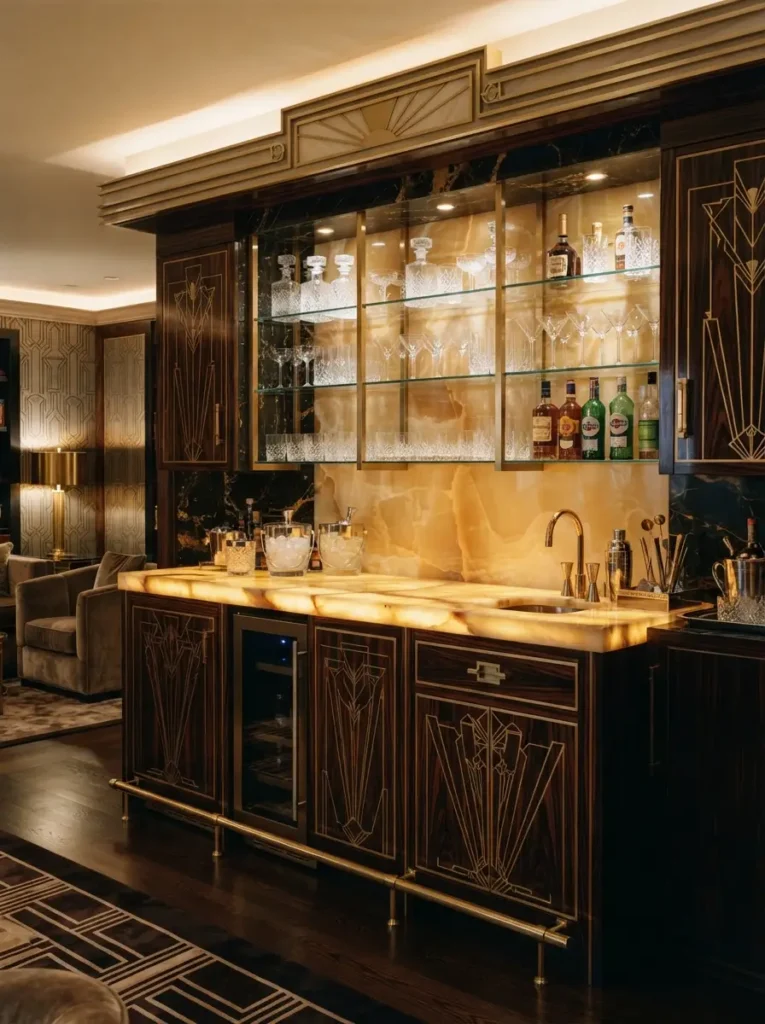
Entertaining and cocktail culture defined the social fabric of the 1920s and 30s. A true Art Deco home does not relegate the liquor to a hidden cabinet; it celebrates the ritual of the cocktail with a dedicated, glamorous bar area.
- The Design Concept: While a rolling bar cart is excellent, a built-in, architectural wet bar is the ultimate Deco flex. It should feel like a portal to a high-end luxury hotel lounge.
- Color & Material Palette: Mirrored backsplashes, thick glass shelving, polished brass rails, and exotic wood veneers like Macassar ebony or burl walnut.
- Architectural Integration: Convert a recessed living room alcove or an under-stair closet into a jewel-box bar. Line the interior entirely in dark geometric wallpaper or smoked mirror, install floating glass shelves, and use hidden LED strips to under-light crystal decanters.
12. Bespoke Inlay and Marquetry
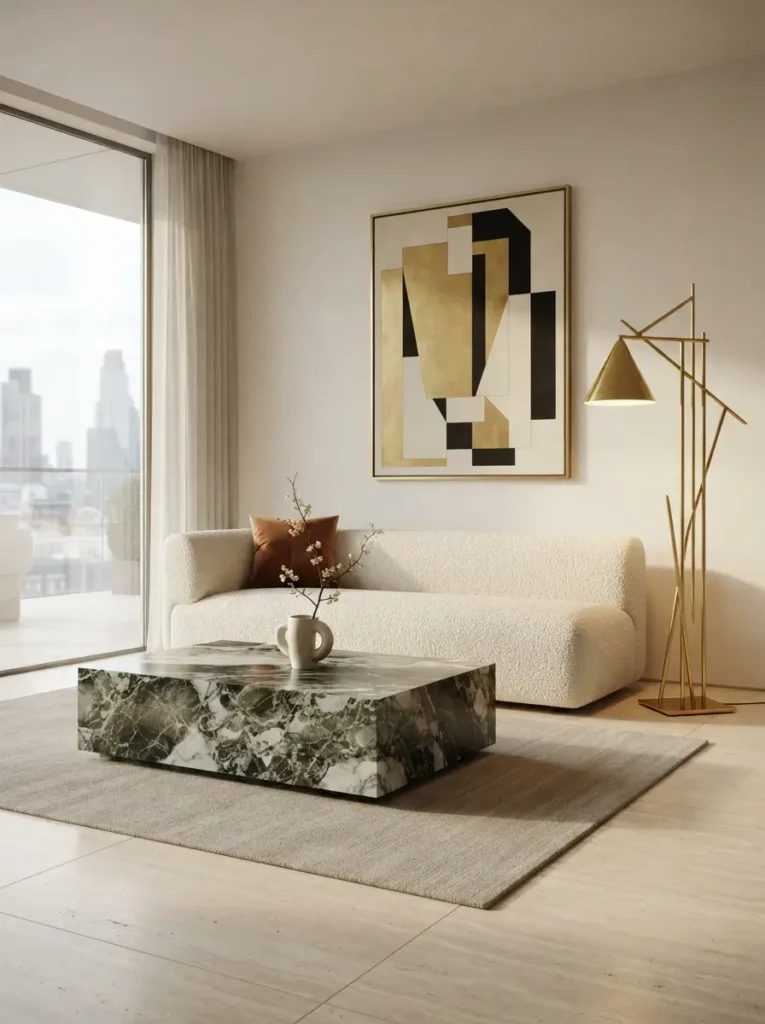
Art Deco represents a peak in artisan craftsmanship. Before the mass production of the mid-century took over, furniture and flooring were defined by intricate, bespoke detailing like inlay and marquetry (the art of applying pieces of veneer to a structure to form decorative patterns).
- The Design Concept: Look for dining tables, sideboards, or doors that feature geometric patterns created by contrasting different shades and grains of wood, or wood inlaid with bone, mother-of-pearl, or brass.
- Color & Material Palette: High-contrast woods. Pale maple inlaid into dark mahogany, or rich burl wood detailed with thin, precise lines of brass.
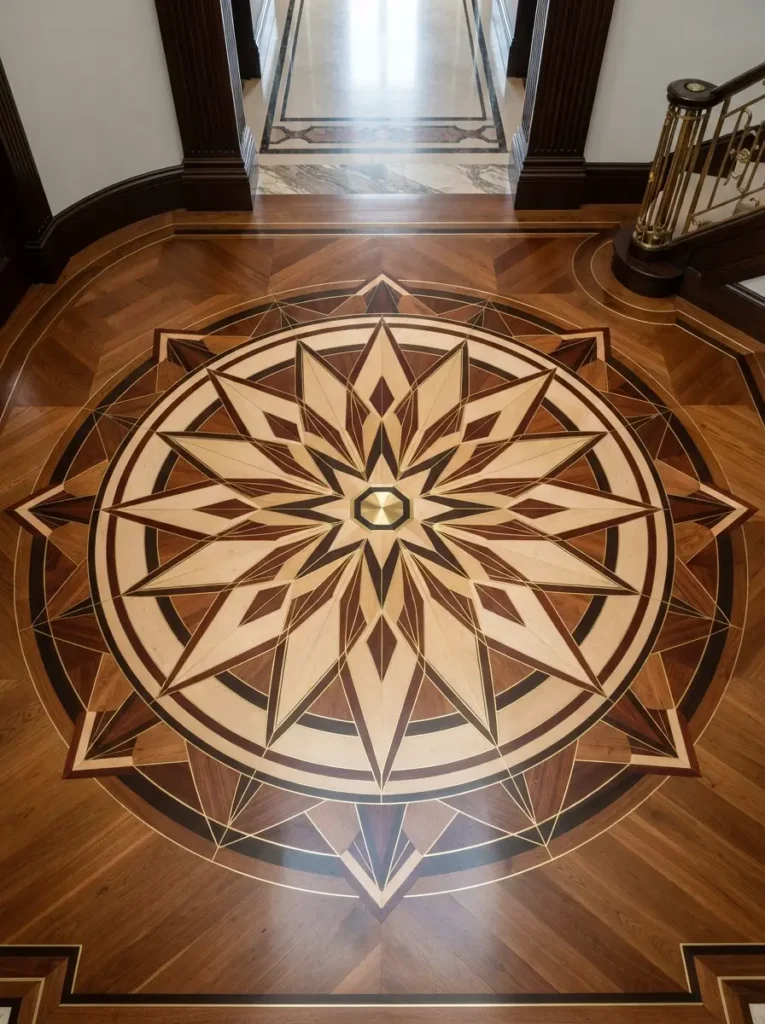
- Architectural Integration: If you are installing hardwood floors, consider a custom border or a central geometric medallion utilizing contrasting wood tones. This elevates the floor from a mere walking surface to an integral piece of the room’s overarching art.
13. Avant-Garde Sculptural Decor
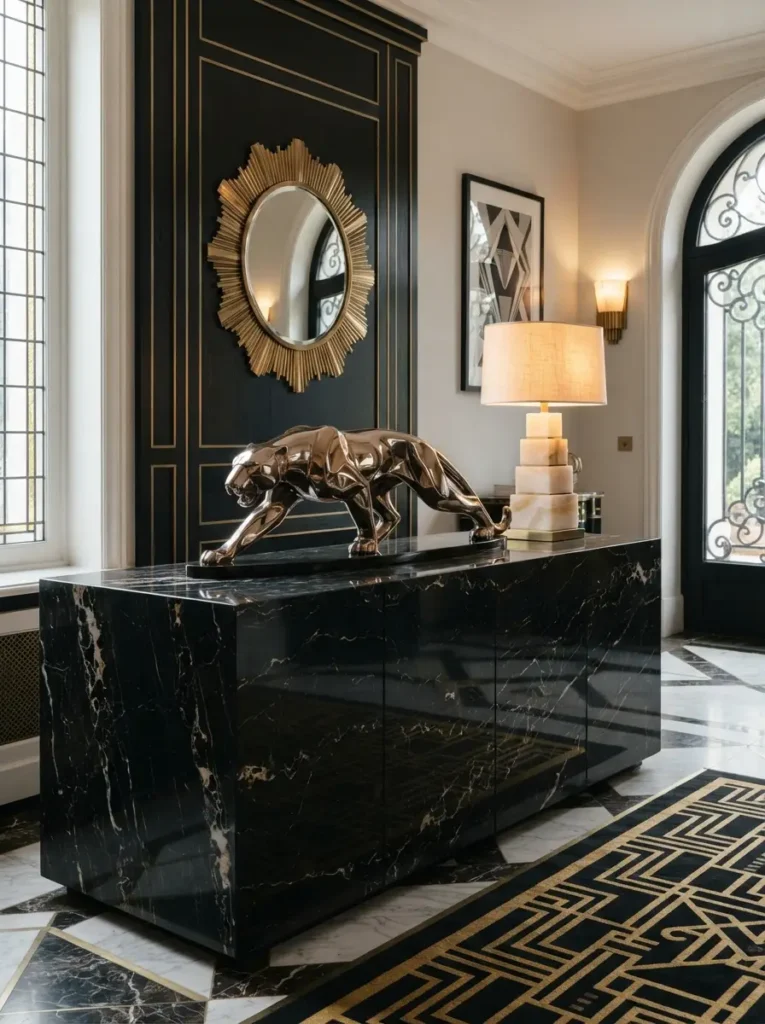
Art Deco styling eschews the clutter of dozens of small knick-knacks. Instead, it relies on a few, carefully selected, large-scale sculptural pieces that command attention and reinforce the architectural themes of the room.
- The Design Concept: The decor should be bold and aerodynamic. Popular motifs include stylized, elongated animals (greyhounds, panthers, gazelles), geometric stepped obelisks, and powerful, abstract human figures.
- Color & Material Palette: Heavy, premium materials. Cast bronze, carved alabaster, black onyx, and polished chrome.
- Architectural Integration: Place a singular, heavy bronze panther sculpture on a marble entryway console, or flank a fireplace mantel with two towering, stepped alabaster obelisks. The sheer weight and material quality of these pieces project permanence and luxury.
14. Stepped Arches and Ziggurat Doorways
To truly embed Art Deco into the bones of a house, look to its signature architectural forms: the stepped arch and the ziggurat (a tiered, terraced shape).
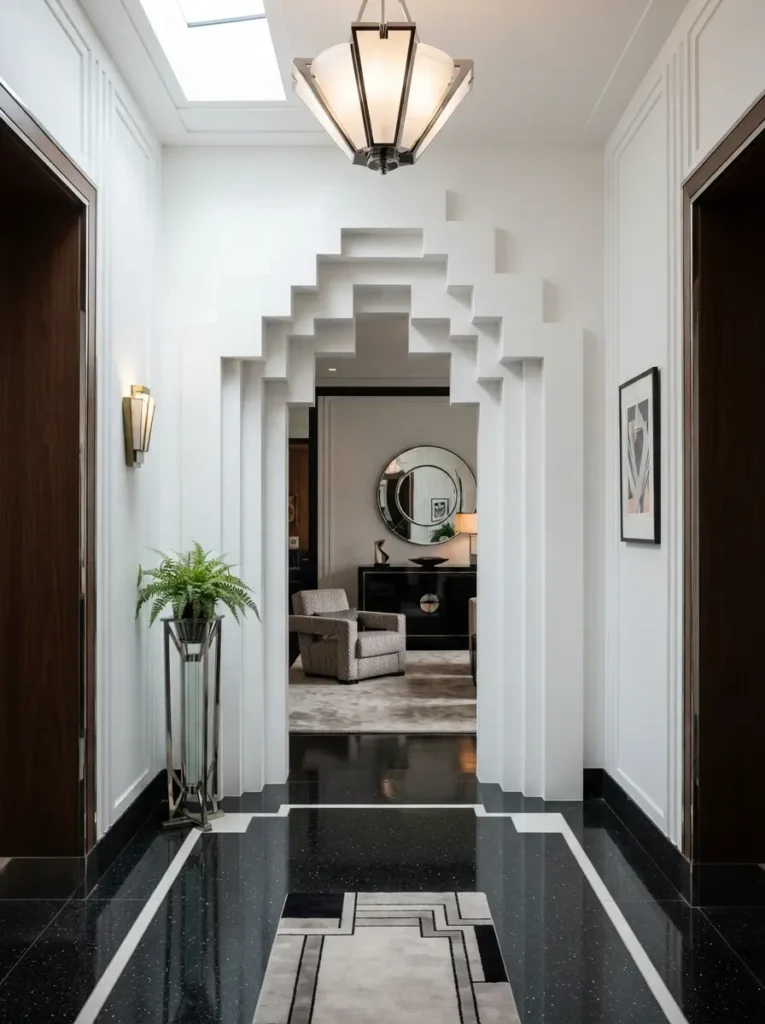
- The Design Concept: Instead of standard rectangular doorways or perfectly smooth, rounded Roman arches, the Deco arch features distinct, stepped right angles that stair-step upward to a flat or slightly curved top, mimicking the crown of the Chrysler Building.
- Color & Material Palette: Crisp, plaster white walls to highlight the shadow lines of the steps, or door frames encased entirely in contrasting dark wood.
- Architectural Integration: If undergoing a renovation, reframe a standard hallway opening or a primary bathroom entrance into a stepped ziggurat archway. It instantly turns a simple transition between rooms into a dramatic architectural event.
15. The Luxurious, Symmetrical Bedroom Sanctuary
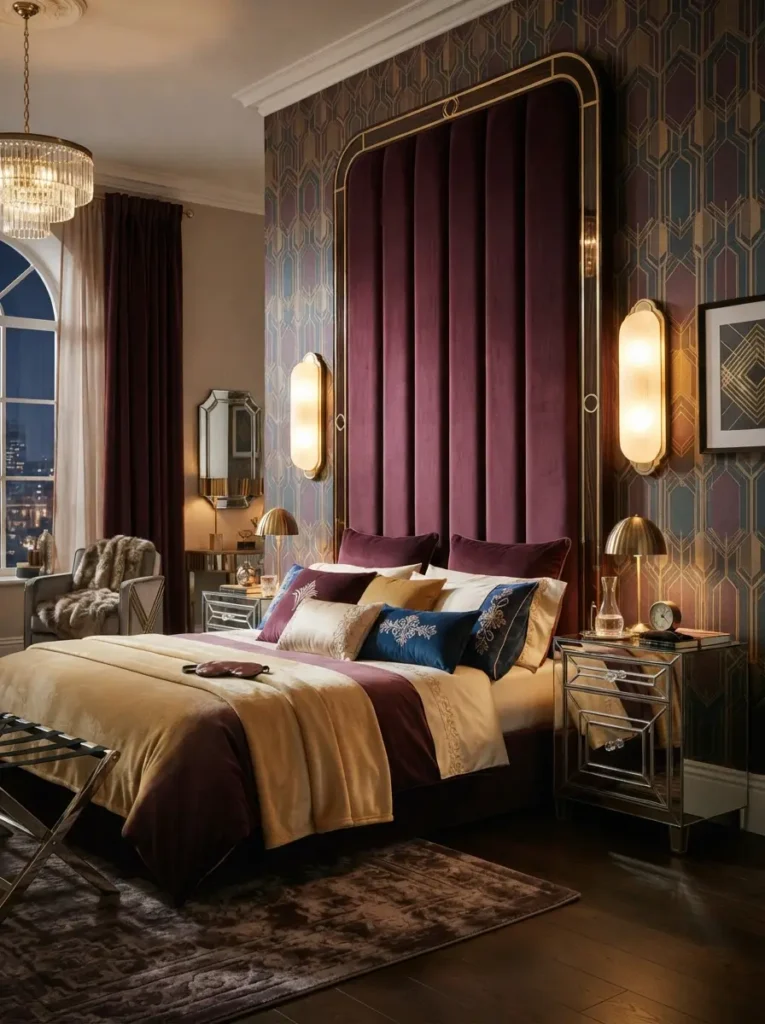
An Art Deco bedroom should feel less like a standard residential room and more like the penthouse suite of a grand 1930s European hotel. It is a space dedicated to lavish comfort, heavy fabrics, and meticulous symmetry.
- The Design Concept: The bed is the absolute center of the universe. It features an oversized, heavily upholstered headboard—often channel-tufted or featuring a dramatic scalloped/arched shape that reaches toward the ceiling.
- Color & Material Palette: Layers of lush texture. Silk sheets, a heavy velvet duvet, and a plush geometric wool rug underfoot. Colors should be calming but rich, like deep teal, champagne, and ivory.
- Architectural Integration: Anchor the oversized headboard with two heavy, mirrored or burl wood nightstands. Above each nightstand, install identical, elongated brass and frosted-glass wall sconces. This creates a deeply comforting, enclosed, and perfectly balanced sleeping environment.
16. The Decadent Black and White Deco Bathroom
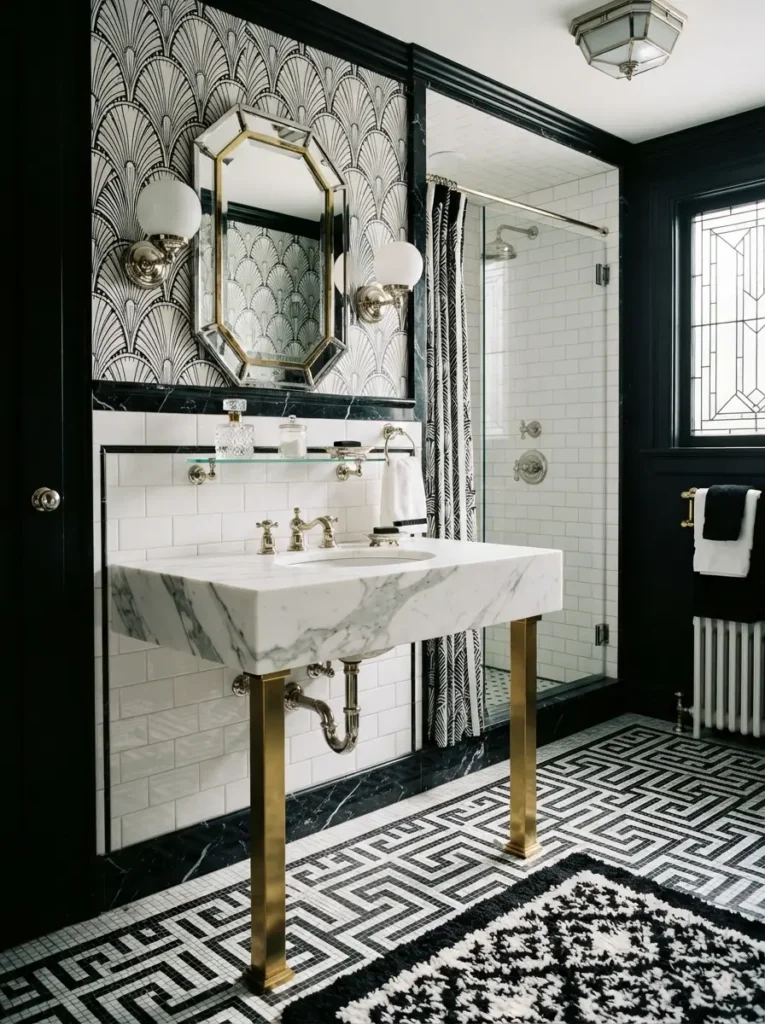
Bathrooms are arguably the most natural spaces to inject pure Art Deco style, as the era produced some of the most beautiful plumbing and tile designs in history.
- The Design Concept: It is an exercise in graphic contrast and exposed, beautiful mechanics. The floor dictates the space, utilizing intricate mosaic tiles to create repeating geometric optical illusions.
- Color & Material Palette: Stark black and white. Hexagon or penny tiles on the floor with black Greek key borders. Thick, white subway tile on the walls ending in a black pencil-liner trim. Exposed, unlacquered brass or polished nickel plumbing.
- Architectural Integration: Install a heavy porcelain pedestal sink or a floating marble vanity with thick brass legs. Pair it with an arched or octagonal tilt-mirror and geometric wall sconces. The rigid black-and-white geometry makes the bathroom feel incredibly clean, while the heavy metals provide undeniable luxury.
17. The 2026 Neo-Deco Minimalism
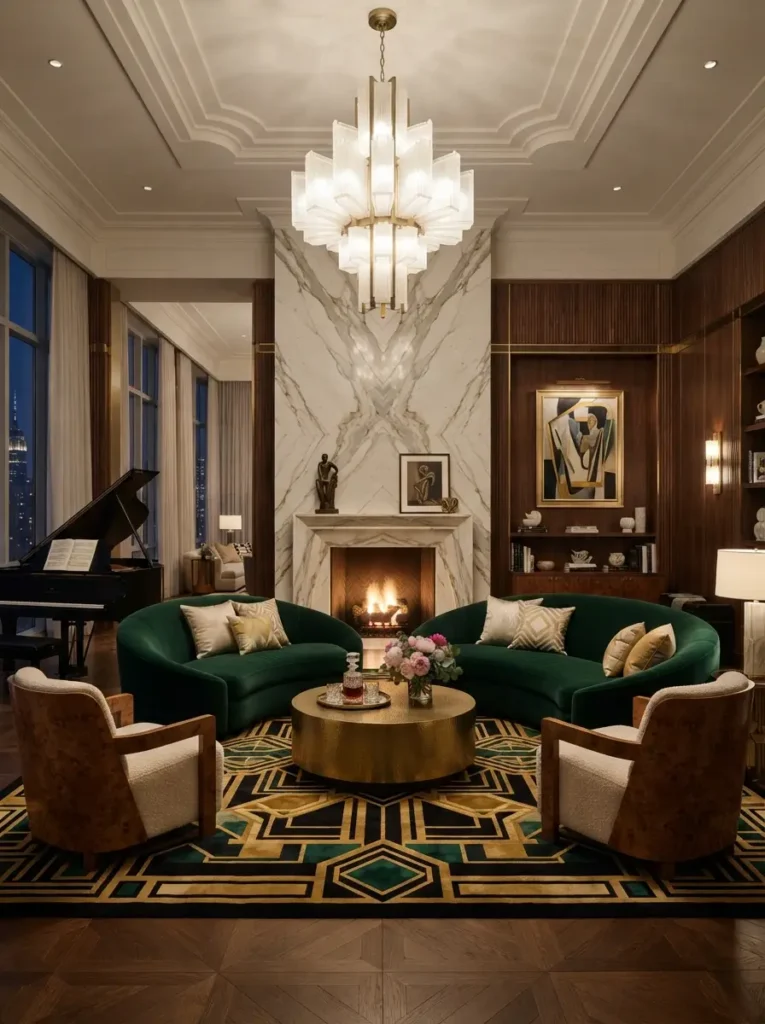
Modern Art Deco is not about creating a museum or a Gatsby-themed movie set. The contemporary 2026 approach is “Quiet Deco.” It strips away the excessive ornamentation of the past and distills the style down to its core: impeccable materials and striking, clean silhouettes.
- The Design Concept: Let the materials do the talking. A room might feature completely bare, white walls, allowing a single, magnificently veined marble table and a striking, angular brass light fixture to command the space without competition.
- Color & Material Palette: A stark, minimalist base—warm whites, pale greys, and muted stones—punctuated by one or two highly saturated Deco elements or heavy metallic features.
- Architectural Integration: It requires flawless execution. Because the room is not cluttered with decor, the eye naturally rests on the joints, the finishes, and the lines of the architecture. Wide-plank floors, perfectly smooth, level ceilings, and flush, trimless doors create a hyper-modern canvas for beautifully crafted Deco furniture to shine.
Designing Your Deco Masterpiece: Balancing Era and Modernity
Integrating such a dominant, historical design style into a contemporary home requires a careful, curated approach. If you apply every single Art Deco element at once, the home can quickly become a caricature—feeling heavy, overwhelming, and theatrical. The secret to mastering Neo-Deco lies in the art of juxtaposition.
To make Art Deco feel fresh and modern, follow the “Rule of Contrast.” If you have a highly ornate, geometric Deco wallpaper, pair it with a sleek, ultra-modern minimalist console table. If you invest in a heavy, classic tufted velvet Deco sofa, surround it with light, contemporary abstract art rather than vintage 1920s posters.
Furthermore, limit your statement metallic finishes. While brass and gold are essential, covering every surface in highly polished metals can look cheap. Mix a primary finish (like unlacquered brass) with matte black hardware or honed (non-shiny) marble to absorb some of the light and ground the space.
Ultimately, prioritize quality over quantity. True Art Deco was born from a celebration of bespoke craftsmanship. One perfectly constructed, beautifully fluted burl wood cabinet will do more to establish an Art Deco atmosphere than a room full of cheap, mass-produced geometric accessories.
The Enduring Legacy of the Roaring Era
Art Deco interior design continues to captivate designers and homeowners a century after its inception because it successfully solved a complex design equation: it figured out how to be simultaneously radically modern and profoundly luxurious. It does not ask you to sacrifice elegance for clean lines, nor does it require clutter to feel rich.
Whether you choose to envelop a dining room in striking geometric wallpaper, invest in a show-stopping sunburst mirror, or anchor your living space with a sweeping velvet sofa, you are bringing a piece of architectural history into your home. The beauty of Art Deco lies in its unwavering confidence. It is bold, it is glamorous, and it remains, without a doubt, one of the most enduring, masterful interior design styles of all time.